Research Question
How does the way teams think together change when AI mediates the process?
Research Goal
This project investigates how generative AI influences designers’ cognition, collaboration, and decision-making throughout the Double Diamond process.
Furthermore, it aims to design an AI agent that supports the preservation of collective exploration, interpretive depth, and human ownership within hybrid intelligence environments.
Outcome
explAIn is a SaaS type ideation AI agent that introduces intentional friction into GenAI workflows to surface hidden thoughts and perspectives within teams, uncover misalignments in collaboration, and deepen collaborative thinking in the age of AI.

Concept Video
[Contribution]
100% - Video editing
Tool : Adobe After effect, Figma
Generative Research
With AI, How do creative teams experience emotional, cognitive, and behavioral shifts in team collaboration?
Methods : Secondary research / Diary Study / Professional Interview
1-1. Secondary Research (Case Study, Literature Review)
Research suggests that while AI improves individual efficiency, it can negatively impact team dynamics and collective creativity.
83% of creative professionals already use Generative AI in their work. (Adobe, 2024).
and,
Increased Automation Bias (+78%)
Increased Conformity Bias (+40%)
Decline in Collective Innovation (-41%)
Drop in Overall Performance (-19%)
1-2. Diary Study
To understand how creative teams integrate AI into their academic workflows and uncover how AI influences team cognition, collaboration dynamics, trust, and decision-making.
[Contribution]
100% - Google form setting / 50% - Research protocol / 50% - Synthesizing / 100% - Synthesizing Visualizing
Participants
5 design graduate students
+ Actively integrate AI in multiple domains
+ Active engagement with design practice or education
Data Collection
Format : Online platform (Google form)
Frequency : twice per week
Duration : About 10 minutes per entry, approximately 40 minutes in total
Data Points (Observed Patterns)


1. AI became a tool for knowledge processing
Used for synthesizing information, structuring ideas, expanding research, and supporting ideation.
2. Teams adopted diverse engagement patterns with AI outputs
AI outputs were used as drafts, multiple variations, and iteratively refined results.
3. Trust in AI remained conditional
Teams relied on source verification, cross-checking, and collaborative discussions to maintain accuracy and context.
4. AI influenced team cognition and emotions
AI introduced uncertainty around authorship, reduced confidence, and affected how people perceived their contributions.
1-3. Professional Interview
Explore how AI integration reshapes collaboration, cognition, and emotional dynamics within real-world design practice.
[Contribution]
50% - Research protocol / 50% - Interview / 50% - Synthesizing / 100% - Synthesizing Visualizing
Participants
6 Professioanls
+ Professional designers, researchers, or strategists working in consultancy, UX research, or innovation roles.
+ Actively integrate AI in multiple domains
Data Collection
Mode: 30-minute Zoom interviews.
Format: Reflection-based conversation using AI Role Typology and AI/Human Involvement Cards as prompts
Supplementary survey: 5-minute pre-interview form capturing role, domain, and AI-tool familiarity.


Evaluative Research
How do teams using GenAI come up with ideas differently from teams that don't?
Methods : Design Sprint Workshop
By observing both AI-supported and non-AI-supported teams in identical sprint settings (Improving online registration system), the research aims to reveal affective (emotional), behavioral, and cognitive mechanisms that emerge in rapid collaborative work.
[Contribution]
50% - Research protocol / 80% - Workshop, Designing Materials / 100% - Synthesizing
Participants
8 Design students
+ Have previous experience working in small teams and some level of familiarity with AI tools.
+ Actively integrate AI in personal work.
Structure
Team A (AI-assisted): Allowed to use AI tools (e.g., ChatGPT, Figma AI, Midjourney) freely.
Team B (Non-AI): Prohibited from using any AI tools.

Observation

Conversation Type
AI Team: Discussions focused on evaluating, selecting, and refining AI-generated outputs
Non-AI Team: Discussions focused on sharing experiences, perspectives, and collaboratively building ideas
Synthesis
Design Process Map
Methods : Journey Mapping
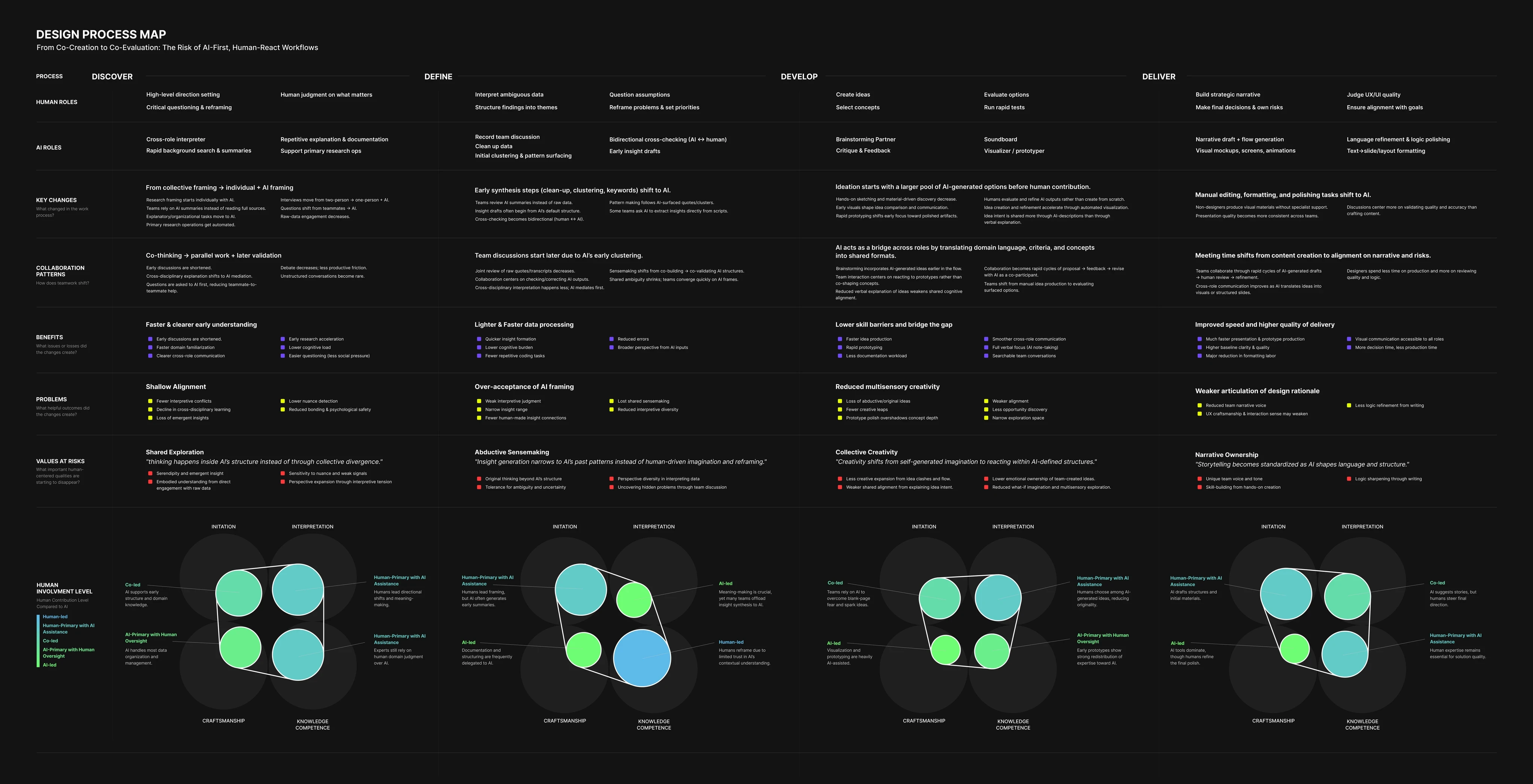
Design Process Map aims to map findings in the design process (Discover – Define – Develop – Deliver), and to identify the design values that are most at risk.
[Contribution]
50% - synthesizing / 100% - designing the map
click image to high resolution
Structure
The map is structured across multiple analytical axes, including:
Human Roles
AI Roles
Key Changes
Collaboration Patterns
Benefits
Problems
Values at Risk
Human Involvement Level
Together, these dimensions surface not only where GenAI accelerates the design workflow, but also how responsibility, cognition, and collaboration are being redistributed between humans and AI.
Human Involvement Level categorizes each stage of the Double Diamond design process into four dimensions to indicate the degree and depth of human cognitive engagement.
[Intention, Interpretation, Craftsmanship, and Knowledge Competence]
4-1. Product Structure

4-2. Design System
[Contribution]
100% - Design system


4-3. Final Solution
[Contribution]
100% - UI Design / 50% - Information architecture

Individual Ideation Session
explAIn provides a structured ideation process before AI generation begins, reducing unstructured AI dependency and encouraging deeper individual thinking.
Explain
Explore
Expand
Users first reflect on the task’s goals, expected outputs, and constraints to establish a clear ideation direction.
Before AI enters the workflow, users explore and expand ideas through a diverging framework that preserves human-centered exploration and independent thinking.
AI then introduces context-aware ideas in a limited card-based format,
encouraging users to read outputs more critically and provide thoughtful feedback. The evolution of ideas is visually tracked, allowing individuals to understand how their thinking developed and how final concepts emerged over time.

Shared Thinking as Team Assets
Understanding the “Why” Behind Ideas
Remixing Instead of Choosing
Insights gathered during individual sessions [concerns, perspectives, and reasoning patterns] become visible assets for the team.
Rather than debating ideas at a surface level, teams align around shared criteria and understand why different perspectives matter.
Ideas are broken into components, recombined, and evaluated against agreed criteria, enabling teams to co-create stronger concepts together.
Team Session
explAIn transforms individual thinking into shared team intelligence.