Generative AI in Design Practice

Recent organizations and design teams are rapidly adopting AI as a means to maximize efficiency, with its applications extending beyond routine automation into more creative and strategic domains such as design, innovation, and collaboration. Within this shift, designers are integrating AI into their work under diverse motivations, including expectations of performance gains, reduced effort, social influence, and enabling conditions, thus forming new kinds of Hybrid Intelligence (HI) teams in which humans and machines collaborate.

Location

New York, Parsons SDM

Date

2025.8~

Focus

Research

Collaborators

Jiwon Pyo

Research Adviser

Cindy Hsiao

Limitations of Existing Research

Existing research linking AI to design work or creativity has primarily focused on short-term, individual-level outcomes. For example, prior studies often highlight AI’s contribution to idea generation, output quality, or self-efficacy. Yet real-world design projects are not short laboratory tasks; they unfold as long-term and iterative processes driven not by a “superhero designer,” but by team-based collaboration that leverages collective intelligence. In consulting and strategy contexts in particular, methodologies such as design thinking, service design, and strategic design extend into branding, product development, and organizational strategy—each being the product of multidisciplinary teamwork.

Research Objective

Accordingly, understanding the role of AI in design projects requires moving beyond individual performance metrics. The critical question is how AI reshapes collaboration, coordination, motivation, and long-term growth at the team level. If AI undermines creative diversity or hinders deep reflection and reframing, it may threaten the very conditions for innovation. Conversely, if it amplifies collaboration at the team level, AI could become a powerful new instrument for organizational innovation. Against this backdrop, the present study seeks to investigate the effects of AI on team-based creativity and collaboration within design projects, and to identify ways in which AI can be harnessed to strengthen these dynamics over the course of long-term engagements.

Research Framework

To systematically analyze the impact of AI on design collaboration, we adopted a theory-driven approach rather than a purely inductive one. We grounded our research in The Wiley Blackwell Handbook of the Psychology of Team Working and Collaborative Processes (Salas et al., 2017), specifically focusing on the 'Teamwork Process and Emergent States.' We merged these three core mechanisms of Behavior, Cognition, and Affect with the Double Diamond Design Process to create a comprehensive analytical lens. This framework allows us to examine not just the output of design, but the underlying psychological and operational shifts occurring within the team.


Research Method 1 - Diary Study

We conducted two-week diary studies with 5 participants, resulting in 13 episodes describing how they use AI in their design team's work. We analyzed team–AI interaction patterns to understand how roles, responsibilities, and collaboration dynamics shift when AI is integrated into the process. These empirical findings from diary studies focus on the behavioral, cognitive, and affective mechanisms that emerge in real-world design team collaborations with AI.


Diary Study Protocol Link


We conducted two-week diary studies with 5 participants, resulting in 13 episodes describing how they use AI in their design team's work. We analyzed team–AI interaction patterns to understand how roles, responsibilities, and collaboration dynamics shift when AI is integrated into the process. These empirical findings from diary studies focus on the behavioral, cognitive, and affective mechanisms that emerge in real-world design team collaborations with AI.


Diary Study Protocol Link


Diary Study Insight

Diary Study Insight

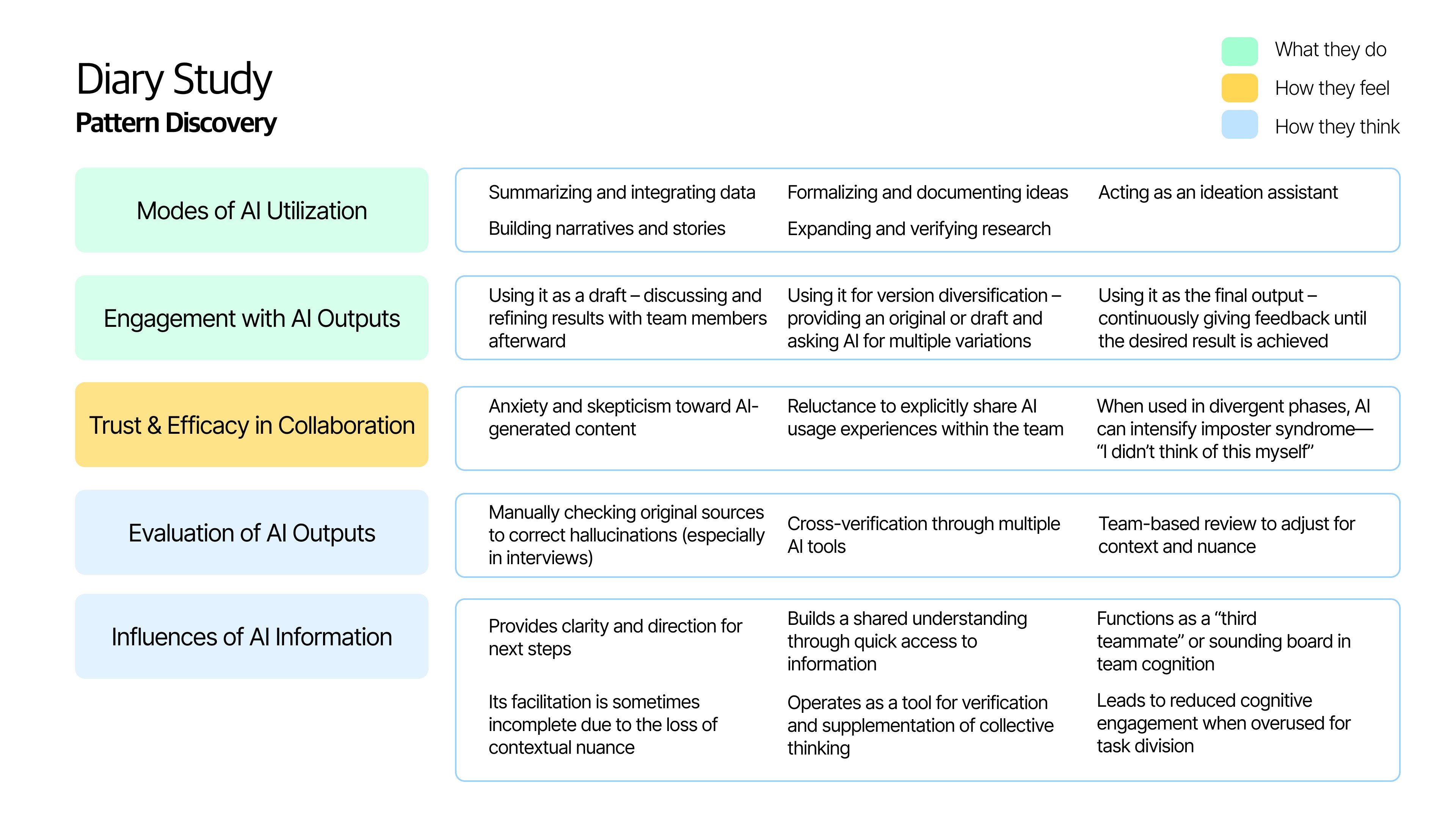
AI was perceived not merely as a tool but as a cognitive partner that structures information and transforms it into meaning. Teams leveraged AI for various cognitive tasks, including documentation, research, ideation, and storytelling, yet final judgment and decision-making remained human-centered.

The human role shifted from proactive exploration to reactive supervision, and the depth of interaction with AI varied depending on task type and expected output quality. Users with high domain expertise performed internal verification and corrections, while those with lower expertise relied on external cross-validation. In some teams, a “reverse evaluation” pattern emerged, where AI was invited to critique human-generated ideas.

Affectively, AI amplified self-efficacy but also induced imposter syndrome and anxiety as human contributions to sense-making diminished. Moreover, while AI functioned as a “third teammate” facilitating information sharing and direction-setting, this often led to context loss and reduced human-to-human interaction, shifting collaboration from exploration toward verification-focused processes.

AI was perceived not merely as a tool but as a cognitive partner that structures information and transforms it into meaning. Teams leveraged AI for various cognitive tasks, including documentation, research, ideation, and storytelling, yet final judgment and decision-making remained human-centered.

The human role shifted from proactive exploration to reactive supervision, and the depth of interaction with AI varied depending on task type and expected output quality. Users with high domain expertise performed internal verification and corrections, while those with lower expertise relied on external cross-validation. In some teams, a “reverse evaluation” pattern emerged, where AI was invited to critique human-generated ideas.

Affectively, AI amplified self-efficacy but also induced imposter syndrome and anxiety as human contributions to sense-making diminished. Moreover, while AI functioned as a “third teammate” facilitating information sharing and direction-setting, this often led to context loss and reduced human-to-human interaction, shifting collaboration from exploration toward verification-focused processes.

Research Method 2 - Co-Creation Workshop

This co-creation workshop explores how design students conceptualize effective teamwork elements and envision speculative, future-oriented AI roles that could reshape team dynamics. By mapping AI roles to teamwork qualities, participants are encouraged to imagine non-traditional, creative, and even provocative possibilities for how AI might collaborate with humans in design teams. The goal is to uncover insights about AI’s potential to augment, transform, or challenge human teamwork—rather than to define fixed roles or frameworks.

Co-creation Workshop Protocol Link


This co-creation workshop explores how design students conceptualize effective teamwork elements and envision speculative, future-oriented AI roles that could reshape team dynamics. By mapping AI roles to teamwork qualities, participants are encouraged to imagine non-traditional, creative, and even provocative possibilities for how AI might collaborate with humans in design teams. The goal is to uncover insights about AI’s potential to augment, transform, or challenge human teamwork—rather than to define fixed roles or frameworks.

Co-creation Workshop Protocol Link


Diary Study + Co-Workshop Insight

Diary Study + Co-Workshop Insight

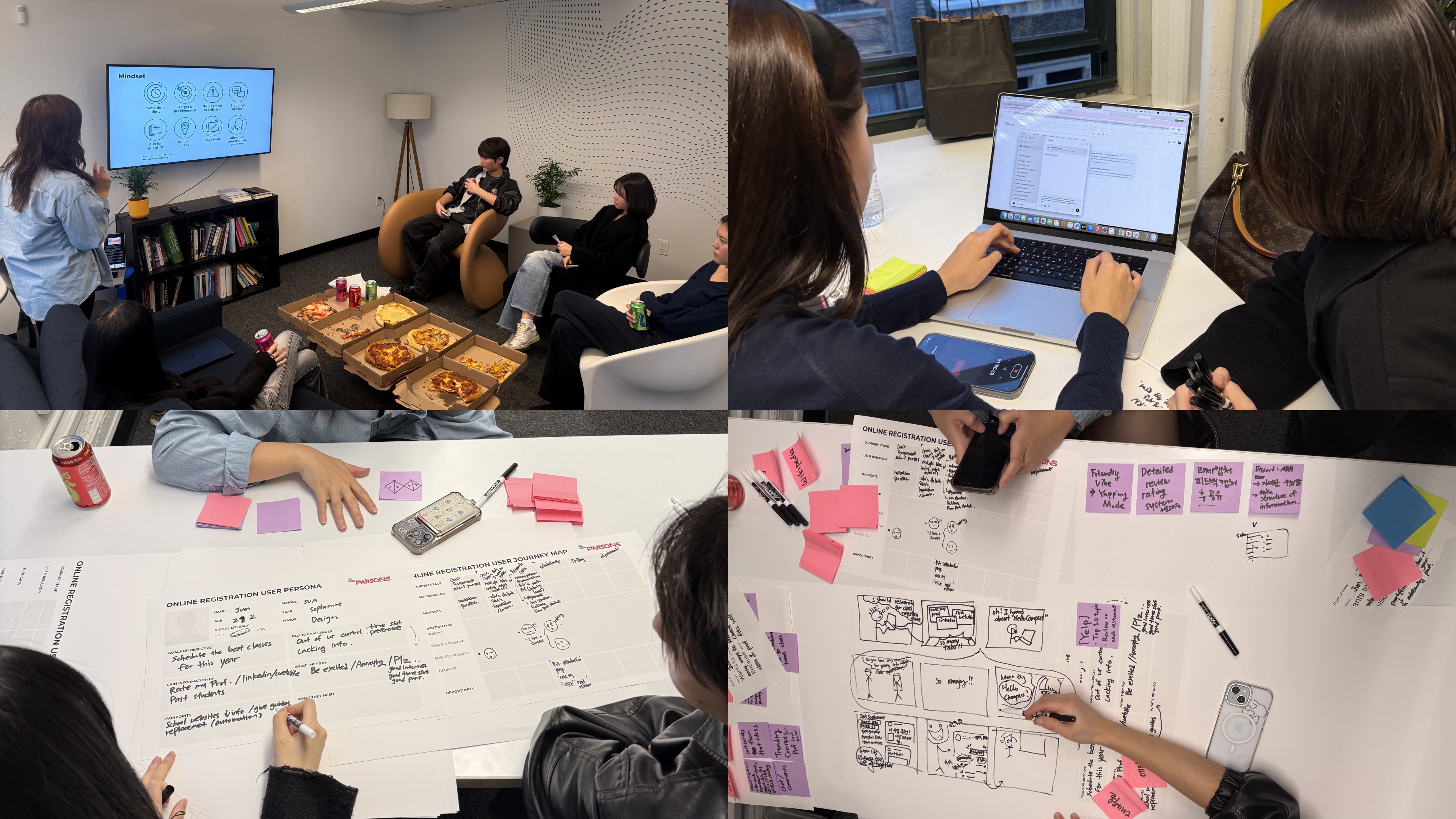
The workshop began with a lecture designed to align students’ understanding of a shared design process and to establish a common analytical framework for the study. Centered on the Double Diamond design process, the lecture explained the purpose and expected outcomes of each phase, creating a shared baseline for the activities that followed.

Students were then divided into two teams and participated in a fast-paced design process workshop. Within a constrained timeframe of one hour, both teams were asked to move through the entire Double Diamond process in a compressed form, including conducting research, gathering materials, defining the problem, and proposing solutions.

Different conditions were applied to the two teams. One team was allowed to freely use AI tools throughout the process, while the other team was prohibited from using AI altogether. This controlled setup enabled a comparison of how the presence or absence of AI influenced both the design process and teamwork dynamics under identical task and time constraints.

Throughout the workshop, the researcher closely observed changes in teamwork dynamics as students rapidly progressed through research, problem definition, and solution development. Particular attention was paid to differences between the AI-enabled team and the non-AI team in terms of collaboration styles, decision-making processes, role distribution, and the intensity of interactions.

The workshop began with a lecture designed to align students’ understanding of a shared design process and to establish a common analytical framework for the study. Centered on the Double Diamond design process, the lecture explained the purpose and expected outcomes of each phase, creating a shared baseline for the activities that followed.

Students were then divided into two teams and participated in a fast-paced design process workshop. Within a constrained timeframe of one hour, both teams were asked to move through the entire Double Diamond process in a compressed form, including conducting research, gathering materials, defining the problem, and proposing solutions.

Different conditions were applied to the two teams. One team was allowed to freely use AI tools throughout the process, while the other team was prohibited from using AI altogether. This controlled setup enabled a comparison of how the presence or absence of AI influenced both the design process and teamwork dynamics under identical task and time constraints.

Throughout the workshop, the researcher closely observed changes in teamwork dynamics as students rapidly progressed through research, problem definition, and solution development. Particular attention was paid to differences between the AI-enabled team and the non-AI team in terms of collaboration styles, decision-making processes, role distribution, and the intensity of interactions.

As a result, a range of distinct patterns emerged across the four phases of the design process. Notably, during the ideation phase, conversations within the AI-enabled team often lacked sustained continuity, and participants frequently cross-checked AI-generated content using other AI tools. These and other observations revealed intriguing patterns related to how AI use shapes interaction, verification practices, and collaborative behavior within design teams.

As a result, a range of distinct patterns emerged across the four phases of the design process. Notably, during the ideation phase, conversations within the AI-enabled team often lacked sustained continuity, and participants frequently cross-checked AI-generated content using other AI tools. These and other observations revealed intriguing patterns related to how AI use shapes interaction, verification practices, and collaborative behavior within design teams.

Research Method 3 - Professional Interview

Generative AI is reshaping design practice beyond automation, extending into ideation, sense-making, and collaboration. Designers integrate AI across all stages of their process, forming hybrid human–machine workflows that demand new ways of thinking, decision-making structures, and role definitions. This research aims to understand how collaboration changes when professional designers and strategists engage both human teammates and AI systems as active collaborators in real-world practice, how cognitive processes and judgment are reconfigured, and how these shifts influence designers’ emotional experiences.

Professional Interview Protocol Link

Generative AI is reshaping design practice beyond automation, extending into ideation, sense-making, and collaboration. Designers integrate AI across all stages of their process, forming hybrid human–machine workflows that demand new ways of thinking, decision-making structures, and role definitions. This research aims to understand how collaboration changes when professional designers and strategists engage both human teammates and AI systems as active collaborators in real-world practice, how cognitive processes and judgment are reconfigured, and how these shifts influence designers’ emotional experiences.

Professional Interview Protocol Link

“ we're running through like 20 interviews in a week like, and it's just like me and one other designer we have to use AI to synthesize what are the common points that's coming out so a lot of the synthesis work afterwards requires a lot of AI ”

Professional Interviewee

Product Designer | BCGX

“If decisions are made based on wrong insights, the accountability falls on me or my team. For research work, accuracy is extremely important. It’s high-stake work.”

Professional Interviewee

UX Researcher | Financial Indistry

Key Findings

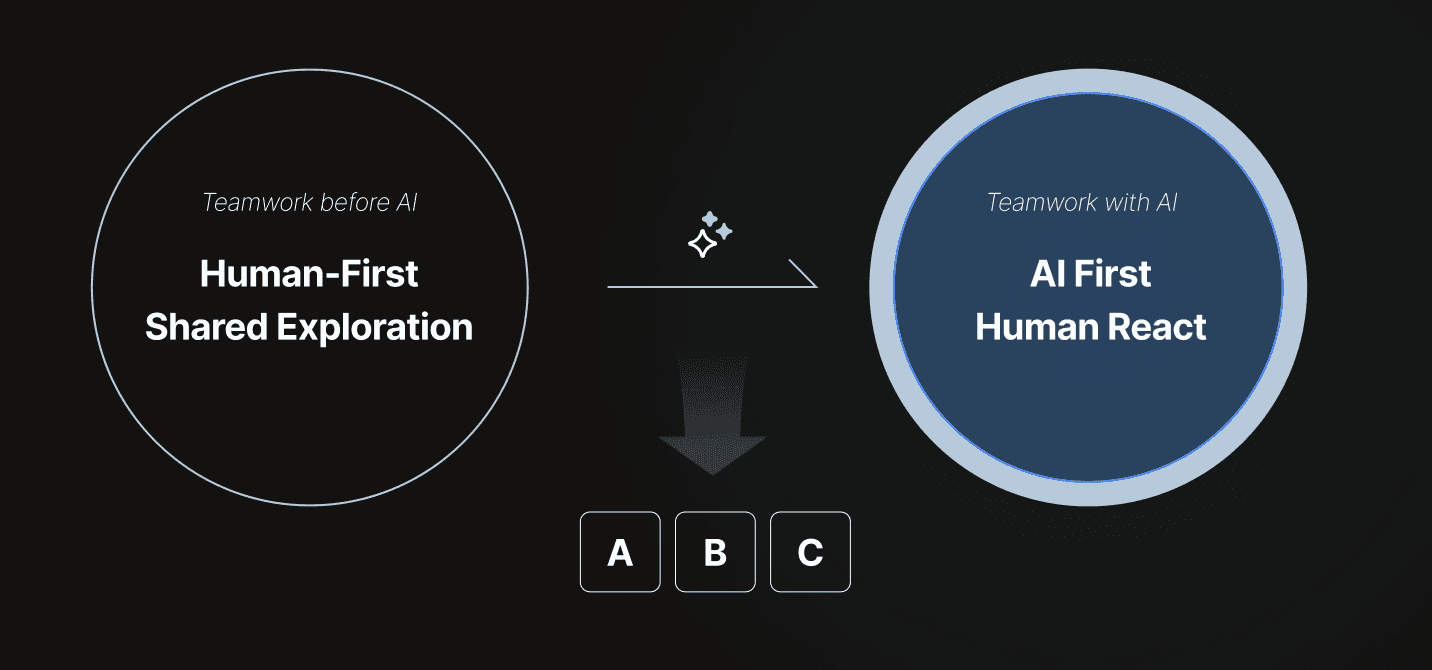
In this study, we analyzed the shift from human-first, shared exploration–based teamwork toward an AI-first, human-react mode of collaboration using three mechanisms from our theoretical framework. As a result, three major shifts were identified.
  1. Trap of Individual Augmentation  (Behavioral Shift) 

Our first finding is a behavioral shift we call the 'Trap of Individual Augmentation.' The logic in many organizations is simple: 'If every designer uses AI to become an Iron Man, the team naturally becomes the Avengers.' But here is the blind spot. While individuals are boosting their own speed, there is almost no discussion on how these 'Iron Men' should actually work together. In short, we have optimized the 'Parts,' but we have neglected the 'Whole.'

One critical example is the subjective boundary of AI use. Everyone agrees on one rule: 'High-stakes tasks need humans.' But the problem is, no one agrees on what is high-stakes.

For one designer, extracting highlights from an interview is critical human work. For another, it's safe enough to delegate to AI. Because these boundaries are individual rather than agreed-upon, collaboration becomes inconsistent, and the quality of work varies drastically within the same team.

Our first finding is a behavioral shift we call the 'Trap of Individual Augmentation.' The logic in many organizations is simple: 'If every designer uses AI to become an Iron Man, the team naturally becomes the Avengers.' But here is the blind spot. While individuals are boosting their own speed, there is almost no discussion on how these 'Iron Men' should actually work together. In short, we have optimized the 'Parts,' but we have neglected the 'Whole.'

One critical example is the subjective boundary of AI use. Everyone agrees on one rule: 'High-stakes tasks need humans.' But the problem is, no one agrees on what is high-stakes.

For one designer, extracting highlights from an interview is critical human work. For another, it's safe enough to delegate to AI. Because these boundaries are individual rather than agreed-upon, collaboration becomes inconsistent, and the quality of work varies drastically within the same team.

  1. The Shift from Explorer to Supervisor weakens collective thinking. (Cognitive Shift) 

Second, we see a shift in human roles from Explorers to Supervisors. AI is great at removing repetitive tasks, but it's also taking over the cognitive 'heavy lifting.' Designers are spending less time actively exploring ideas and more time just reviewing and fixing AI outputs. Under time pressure, many design students used AI to summarize interview scripts and extract key findings. This is common in professional settings, too. One consultant said AI saved him significant research time by highlighting and synthesizing interviews. He interviewed 14 people and completed his research in two weeks. 

However, as an expert warned, true creativity comes from ‘imperfect exploration.’ When individuals stop wrestling with problems and start just checking answers, the entire team risks becoming a ‘shallow-thinking entity.’ We lost our collective muscle to define and interpret complex issues deeply. 

Second, we see a shift in human roles from Explorers to Supervisors. AI is great at removing repetitive tasks, but it's also taking over the cognitive 'heavy lifting.' Designers are spending less time actively exploring ideas and more time just reviewing and fixing AI outputs. Under time pressure, many design students used AI to summarize interview scripts and extract key findings. This is common in professional settings, too. One consultant said AI saved him significant research time by highlighting and synthesizing interviews. He interviewed 14 people and completed his research in two weeks. 

However, as an expert warned, true creativity comes from ‘imperfect exploration.’ When individuals stop wrestling with problems and start just checking answers, the entire team risks becoming a ‘shallow-thinking entity.’ We lost our collective muscle to define and interpret complex issues deeply. 

  1. Efficiency at the Cost of Connection (Affective Shift) 

Third, we observe the emergence of 'Solo Loops.' Designers increasingly rely on AI instead of colleagues. While this might seem efficient by reducing meetings and operational work, it undermines the 'Shared Reasoning' within the team. One interviewer noted AI prototyping bridges designers and non-designers visually; however, it can also make ideas seem too fancy and distract from the main point. Another researcher mentioned that she tends to consult AI for research methods when the research is not highly complex or domain-specific. As a result, team communication becomes fragmented. We are witnessing a shift from 'Collaboration' to 'Individual Division of Labor,' where the team functions as a collection of individuals working in silos, each with their own AI agents. In the long run, this trend may weaken team trust and confidence. 


Third, we observe the emergence of 'Solo Loops.' Designers increasingly rely on AI instead of colleagues. While this might seem efficient by reducing meetings and operational work, it undermines the 'Shared Reasoning' within the team. One interviewer noted AI prototyping bridges designers and non-designers visually; however, it can also make ideas seem too fancy and distract from the main point. Another researcher mentioned that she tends to consult AI for research methods when the research is not highly complex or domain-specific. As a result, team communication becomes fragmented. We are witnessing a shift from 'Collaboration' to 'Individual Division of Labor,' where the team functions as a collection of individuals working in silos, each with their own AI agents. In the long run, this trend may weaken team trust and confidence. 


Synthesis - Design Process Map

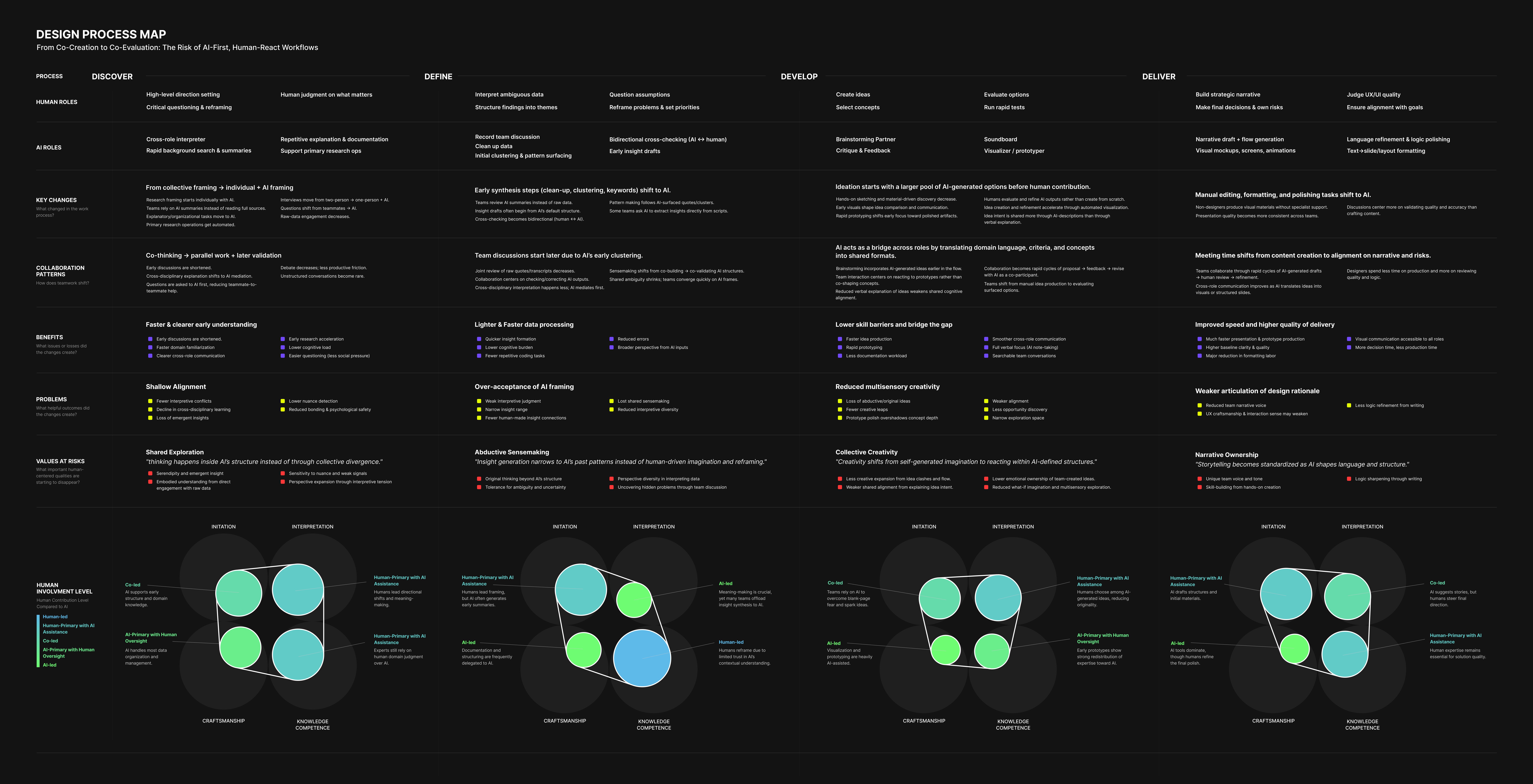
Design Process Map aims to capture surface-level changes in the design process (Discover – Define – Develop – Deliver) after the introduction of GenAI, and to identify the design values that are most at risk.

The map shows that GenAI rapidly accelerates the visual and execution stages of design, enabling ideation, early synthesis, prototyping, documentation, and polishing to proceed far more quickly while shifting designers’ work from creating concepts to evaluating and refining AI outputs. This efficiency helps teams move quickly with fewer resources, but it compresses the collaborative interpretation, human-driven divergence, and exploratory thinking that traditionally enabled deeper insight and long-term innovation.


Link to full image

Design Process Map aims to capture surface-level changes in the design process (Discover – Define – Develop – Deliver) after the introduction of GenAI, and to identify the design values that are most at risk.

The map shows that GenAI rapidly accelerates the visual and execution stages of design, enabling ideation, early synthesis, prototyping, documentation, and polishing to proceed far more quickly while shifting designers’ work from creating concepts to evaluating and refining AI outputs. This efficiency helps teams move quickly with fewer resources, but it compresses the collaborative interpretation, human-driven divergence, and exploratory thinking that traditionally enabled deeper insight and long-term innovation.


Link to full image

Co-evaluation
describes a collaboration pattern where AI generates, structures, and proposes content first, and humans primarily respond by reviewing, selecting, and refining these outputs together. Rather than building ideas collaboratively, teams increasingly gather to judge, align, and validate AI-generated material.
Co-creation
refers to a mode of collaboration where teams collectively frame problems, generate ideas, and build meaning together through continuous interaction. In this model, design work emerges from shared exploration—ideas are not pre-generated but developed through dialogue, negotiation, and iterative sense-making among team members.

Opportunity Framing 

Opportunity Framing 

AI systems require redesign from a fundamentally different starting point. The guiding question cannot be "How do we make individuals more productive?" It must be: "How do we preserve and strengthen the practices that generate collective creativity?"

We propose four core values to guide this reorientation:

Explore Together. AI should create spaces for teams to discover together, not just tools for solo work to be reviewed later. 

Imagine “What If”.  AI should provoke multiple interpretations and reframings, not just identify patterns or provide ready-made answers.

Build on Each Other.  AI should amplify what emerges when people collaborate, not just scale what individuals can do alone. 

Own our Story. AI should help us carefully construct meaning, not auto-generate stories for us to approve. 

These values represent more than additional features or refinements to existing systems. They require a fundamental reorientation of purpose and design principles. AI systems for design work must be rebuilt to center the practices that sustain human creativity and enable collective innovation: collaboration, interpretation, and exploratory thinking.


AI systems require redesign from a fundamentally different starting point. The guiding question cannot be "How do we make individuals more productive?" It must be: "How do we preserve and strengthen the practices that generate collective creativity?"

We propose four core values to guide this reorientation:

Explore Together. AI should create spaces for teams to discover together, not just tools for solo work to be reviewed later. 

Imagine “What If”.  AI should provoke multiple interpretations and reframings, not just identify patterns or provide ready-made answers.

Build on Each Other.  AI should amplify what emerges when people collaborate, not just scale what individuals can do alone. 

Own our Story. AI should help us carefully construct meaning, not auto-generate stories for us to approve. 

These values represent more than additional features or refinements to existing systems. They require a fundamental reorientation of purpose and design principles. AI systems for design work must be rebuilt to center the practices that sustain human creativity and enable collective innovation: collaboration, interpretation, and exploratory thinking.


Design Concept: Thinking Room

Design Concept: Thinking Room

In process.

In process.

Co-creation
refers to a mode of collaboration where teams collectively frame problems, generate ideas, and build meaning together through continuous interaction. In this model, design work emerges from shared exploration—ideas are not pre-generated but developed through dialogue, negotiation, and iterative sense-making among team members.

Co-evaluation
describes a collaboration pattern where AI generates, structures, and proposes content first, and humans primarily respond by reviewing, selecting, and refining these outputs together. Rather than building ideas collaboratively, teams increasingly gather to judge, align, and validate AI-generated material.